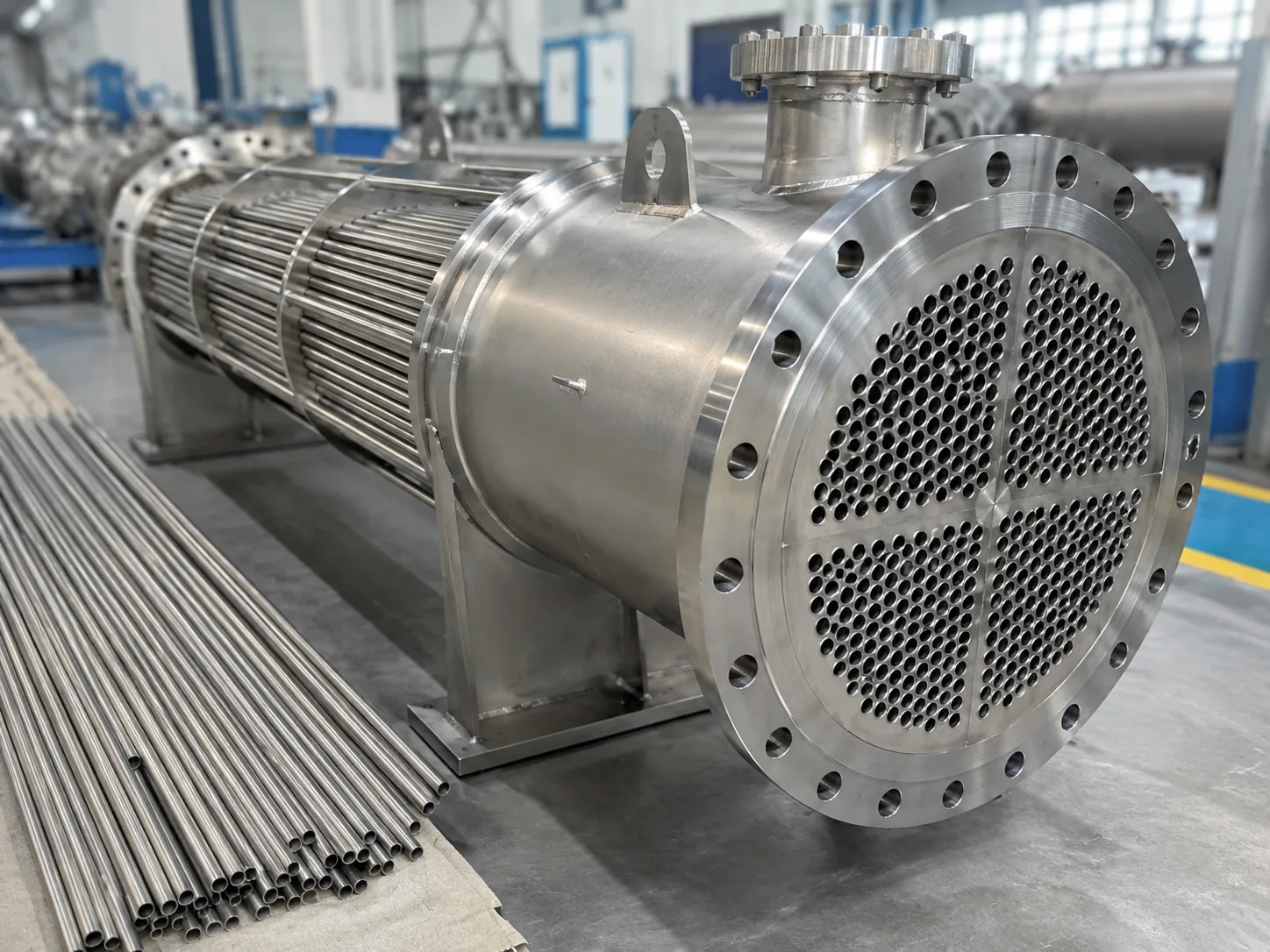
ASTM B338 is one of the most frequently cited specifications in titanium condenser and heat-exchanger tube procurement. For a buyer, however, writing only “ASTM B338 titanium tube” is not enough to obtain comparable quotations. A workable RFQ also has to define the grade, seamless or welded construction, outside diameter, wall thickness, length, quantity, inspection requirements, documentation and delivery conditions.
What ASTM B338 covers
As of 2026, ASTM's current nonferrous standards catalog lists ASTM B338-17(2026). Project documents may cite another approved edition, so procurement should follow the edition stated by the purchaser or engineer.
ASTM describes B338 as a specification for seamless and welded titanium and titanium-alloy tubes intended for surface condensers, evaporators and heat exchangers. The standard includes multiple commercially pure and alloyed titanium grades and distinguishes manufacturing routes for seamless and welded tubing.
That scope matters because it tells the supplier the governing product specification, but it does not replace your equipment drawing, tube sheet design or project purchase specification. A quotation still needs the exact tube geometry and service-related requirements.
Five decisions to make before requesting a quote
1. Grade
State the ASTM grade explicitly. Grade 2 is a common industrial choice, but project chemistry, temperature, corrosion environment and owner specifications may require another grade.
2. Construction
Specify seamless, welded or another permitted condition when the project requires it. Do not assume the supplier will infer the route from the application.
3. Dimensions
Give OD × wall thickness × length, preferably with units on every value. For fixed-length heat exchanger tubes, also state permitted length tolerance if the project has one.
4. Inspection
Identify required NDT, pressure testing, dimensional inspection and any project-specific acceptance criteria rather than writing only “full inspection.”
5. Documents
State whether you need a material test certificate, heat/lot traceability, NDT reports, dimensional report, packing list, certificate of origin or third-party inspection.
Seamless vs. welded under B338
ASTM B338 covers both seamless and welded tube. The manufacturing route changes how the tube is produced and can affect availability, economics and inspection planning. For procurement purposes, the correct question is not “which route is always better?” but “which route does the equipment design, project specification and purchaser acceptance plan require?”
For more detail, compare our titanium seamless tube and titanium welded tube pages, or read the dedicated seamless vs. welded buyer guide.
Inspection language should be specific
The current ASTM B338 scope and abstract describe mechanical, flattening and nondestructive/pressure-testing requirements that differ by tube condition. A purchase order may also add project requirements. Buyers should therefore avoid vague clauses such as “NDT required” and instead identify the required method, extent, acceptance basis and report requirement.
| RFQ field | Good procurement wording | Why it matters |
|---|---|---|
| Product | Titanium heat exchanger tube | Separates tubing from pipe or general hollow products. |
| Standard | ASTM B338, latest project-approved edition | Defines the governing product specification. |
| Grade | Grade 2 | Controls material chemistry/properties and price. |
| Construction | Seamless / welded, as required | Affects manufacturing route and availability. |
| Dimensions | OD × WT × fixed/random length | Essential for production and weight calculation. |
| Quantity | Pieces, meters or total weight | Needed for MOQ, yield and freight planning. |
| Testing | State NDT / pressure / dimensional requirements | Prevents different suppliers quoting different scopes. |
| Documentation | MTC + NDT report + traceability, as applicable | Defines the deliverable quality dossier. |
Common RFQ mistakes
- Using “pipe” and “tube” interchangeably. Heat-transfer tubing is normally purchased by precise OD and wall requirements; naming the product clearly reduces ambiguity.
- Leaving the grade open. “Titanium tube” can refer to many grades with different chemistry and economics.
- Omitting length and quantity. These directly affect raw-material planning, yield, packing and freight.
- Quoting a standard without project additions. Owner or EPC specifications can add tighter inspection, documentation or tolerance requirements.
- Sending only a drawing with no written scope. A short RFQ summary makes technical review faster and reduces interpretation risk.
When to send a drawing or tube schedule
If the order contains many tube sizes, fixed lengths, special end conditions or project-specific tolerances, attach a tube schedule or drawing. For replacement bundles, identify whether dimensions were measured from existing tubes or taken from an approved equipment drawing.
At receipt, check package identification against the purchase order, verify heat or lot traceability, review the material certificate, confirm dimensions on a representative inspection plan and review required NDT/pressure-test reports. Any damage, mixed marking or document mismatch should be quarantined before material is released to fabrication.
Receiving inspection after delivery
For projects with a formal vendor document requirement list, issue that list with the RFQ. Document preparation, third-party witnessing and hold points can affect lead time even when the tube itself is available.
Build a technical comparison before negotiating price. Confirm that every bid is based on the same grade, manufacturing route, dimensions, quantity, testing, documentation, packing and delivery term. If one supplier quotes a different standard edition, alternative route or reduced inspection scope, show that as a deviation rather than treating the price as directly comparable.
How to compare B338 quotations fairly
Reference sources
Reference: ASTM B338 specification page. The purchase order and the edition approved by your project remain controlling.
Send your titanium tube RFQ
Send grade, standard, dimensions, quantity, inspection requirements and delivery destination. Drawings and BOM files can be sent by email or WhatsApp.
 Scan to chat on WhatsApp