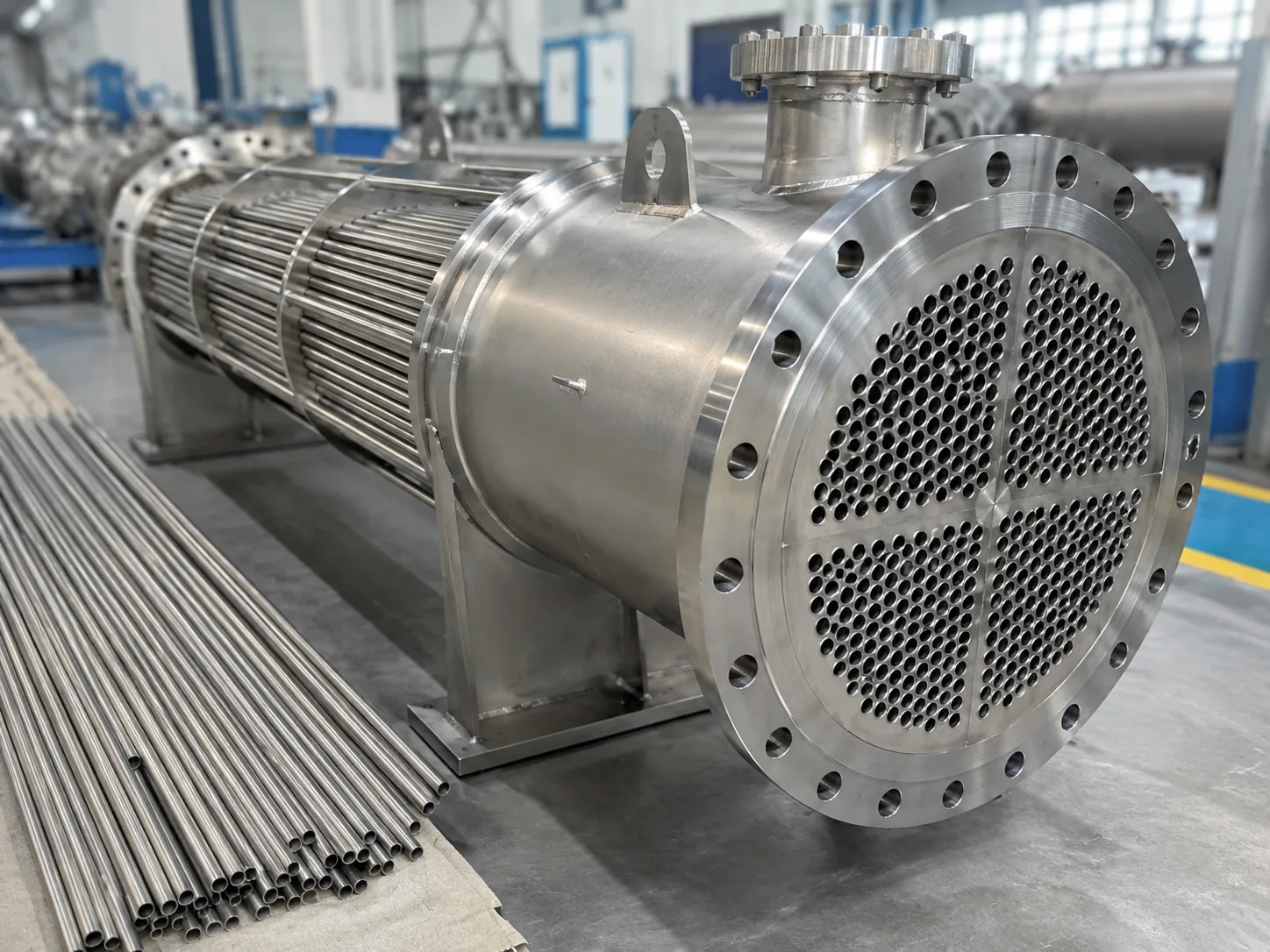
ASTM Grade 2 is a commercially pure titanium grade widely used in industrial equipment where corrosion resistance, fabricability and practical availability have to be balanced. Heat exchangers, condensers, seawater systems and chemical-process equipment are common procurement contexts for Grade 2 tubing.
Why buyers frequently encounter Grade 2
TIMET describes its ASTM Grade 2 equivalent as a commercially pure titanium grade used extensively in seawater piping, reactor vessels and heat exchangers across chemical processing, petrochemical, oil and gas, and marine markets. Its combination of corrosion resistance, ductility and formability explains why it appears so often on industrial material lists.
For heat exchanger tubing, the grade is commonly paired with a product specification such as ASTM B338. The equipment designer or project specification should determine whether Grade 2 is appropriate for the actual medium, temperature, pressure and corrosion mechanism.
Grade 2 is not a substitute for corrosion review
No metal should be selected from a generic “corrosion resistant” label alone. The process medium, concentration, contaminants, temperature, pH, oxidizing/reducing conditions, crevice geometry and galvanic environment can all change material behavior. Where the service is aggressive or unusual, the final material selection should be confirmed by the equipment/materials engineer.
What to specify for a Grade 2 tube RFQ
| Item | What to state | Procurement purpose |
|---|---|---|
| Grade | ASTM Grade 2 / UNS R50400, if required by project | Avoids mixing CP titanium grades. |
| Tube standard | For example ASTM B338 when applicable | Defines the product requirements. |
| Route | Seamless or welded | Controls the manufacturing basis quoted. |
| Dimensions | OD × wall × length | Defines the tube geometry. |
| Quantity | Pieces / meters / weight | Determines production and commercial scale. |
| Surface / ends | State project requirements | Prevents assumptions about finishing. |
| Inspection | NDT, pressure test, dimensional checks | Aligns supplier scope with purchaser ITP. |
| Documents | MTC, traceability, NDT reports, etc. | Defines the turnover dossier. |
Heat exchanger tube purchasing priorities
Dimensional consistency
Tube-to-tubesheet assembly and bundle fabrication depend on consistent outside diameter, wall thickness, straightness and length. If your exchanger design has tighter tolerances than the material standard, put those limits in the RFQ.
Clean surface and traceability
For heat-transfer equipment, buyers often require clean tube surfaces and clear heat/lot traceability. State any cleaning, marking, packaging or contamination-control requirements before quotation.
Testing matched to the project
The applicable product standard contains baseline tests, while EPC or owner specifications may add inspection steps. Send the inspection and test plan when available so quotations include the same scope.
Where Grade 2 is commonly considered
Condensers & coolers
Especially where cooling water quality makes corrosion resistance important.
Seawater service
Grade 2 titanium is widely used in marine and seawater-related equipment, subject to complete design review.
Chemical processing
Used in process equipment where titanium is compatible with the actual chemical environment.
Desalination
Titanium tubing is established in thermal desalination equipment, including heat-transfer service.
Related product pages
Review our titanium heat exchanger tube, titanium seamless tube and titanium welded tube pages before preparing your inquiry.
- Can the requested OD, wall and fixed length be supplied in the required route?
- What is the proposed production and inspection sequence?
- Which tests and reports are included in the quoted price?
- How will tubes be marked, bundled and protected for transport?
- What technical deviations, if any, are being taken from the RFQ?
Questions buyers should ask the supplier
For traceable industrial procurement, the material certificate should be consistent with the ordered grade and product standard and should identify the relevant heat or lot. Buyers should also verify that chemistry and mechanical-property reporting, product dimensions and test records align with the purchase-order requirements. If the project has an approved-vendor or third-party-inspection requirement, include it before order placement.
Material certificate review
A Grade 2 quotation should not be evaluated on unit price alone. Compare the exact standard, route, dimensional tolerances, fixed-length requirements, inspection plan, document package and packing basis. A quote that excludes testing or uses a different length basis can appear cheaper while representing a different technical scope.
How to compare Grade 2 quotations
Reference sources
References: TIMET Grade 2-equivalent data sheet; ASTM B338 scope.
Send your titanium tube RFQ
Send grade, standard, dimensions, quantity, inspection requirements and delivery destination. Drawings and BOM files can be sent by email or WhatsApp.
 Scan to chat on WhatsApp