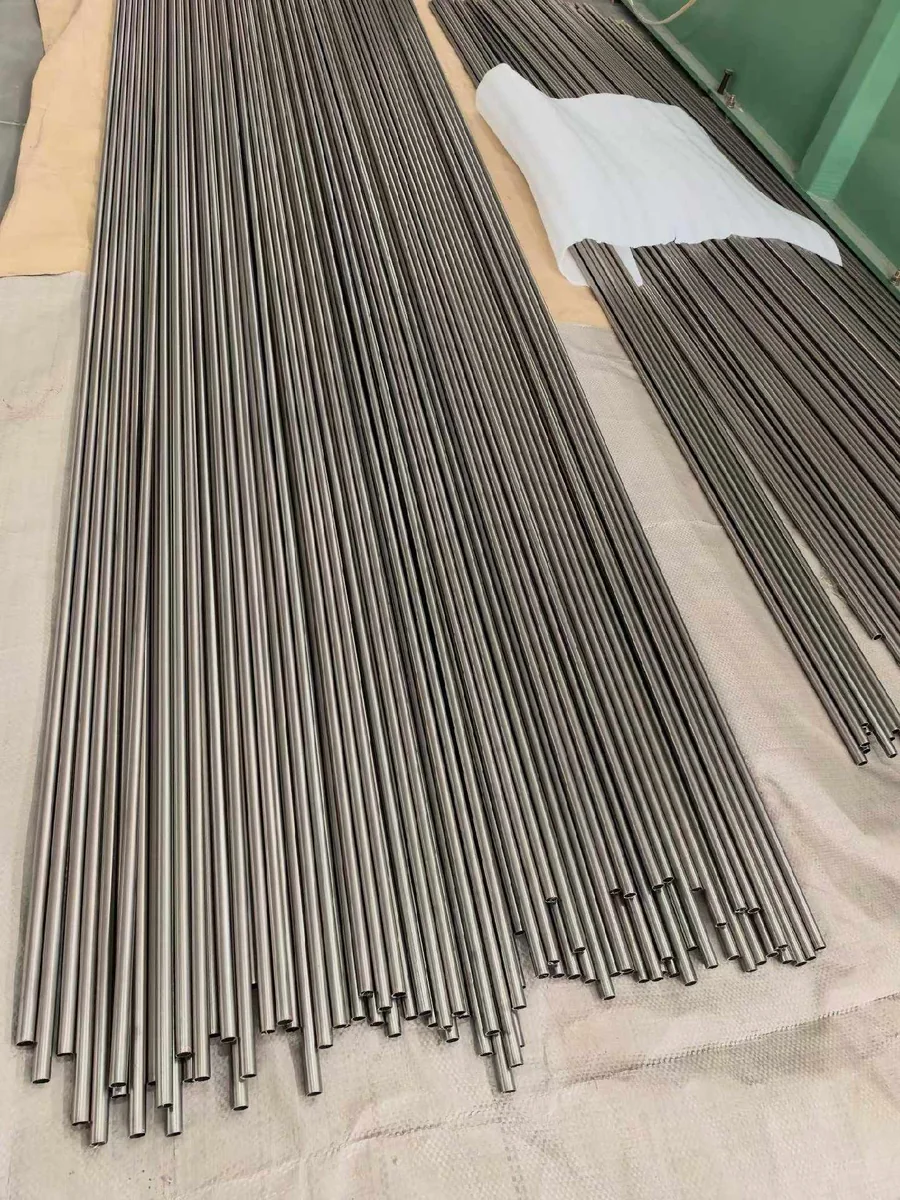
Most slow titanium tube quotations are not caused by the price calculation. They are caused by missing technical information. A supplier cannot reliably price material yield, production route, testing, packing and delivery when the RFQ contains only a product name and approximate quantity.
The minimum technical information
| RFQ item | Example format | Why suppliers need it |
|---|---|---|
| Product | Titanium heat exchanger tube | Defines the product family and intended specification route. |
| Grade | Grade 2 | Determines material chemistry and commercial basis. |
| Standard | ASTM B338 | Defines the baseline product requirements. |
| Manufacturing route | Seamless / welded / either permitted | Prevents technical ambiguity. |
| Size | OD × wall thickness × length | Needed for manufacturing and weight calculation. |
| Quantity | 2,400 pcs or 8,000 m | Determines lot size, yield and logistics. |
| Inspection | NDT / pressure / dimensional / third party | Defines the inspection cost and schedule. |
| Documentation | MTC, NDT report, inspection report | Defines the final quality dossier. |
| Delivery | Required date + destination | Needed for production and freight planning. |
1. Name the product correctly
State whether you need heat exchanger tube, seamless tube, welded tube or another product form. Do not rely on “titanium pipe” as a catch-all term when the application actually requires close-tolerance heat-transfer tubing.
2. Give the grade and standard together
A grade identifies the material, while a product standard defines how the tube is manufactured, tested and accepted. Buyers should state both. If the project uses an owner specification in addition to ASTM/ASME requirements, attach it or list the relevant clauses.
3. Write dimensions unambiguously
Use OD × wall × length and include units. If the order contains multiple sizes, send a spreadsheet or tube schedule with one line per item. For fixed-length tubes, state whether the quoted length is finished length and whether special tolerances apply.
4. Define quantity in a usable unit
Pieces are usually easiest for fixed-length exchanger tubes, while meters or kilograms may be useful for other products. If you provide only total equipment quantity, the supplier may still need the detailed tube count or material take-off.
5. Separate mandatory tests from optional requests
List mandatory inspection and documentation requirements clearly. If a third-party inspection agency must witness a test or review documents before shipment, state this at RFQ stage because it affects both lead time and cost.
6. Include packing and shipping constraints
Long thin-wall tubes can require careful packing to control handling damage. State the destination country, delivery term if known, maximum package length/weight, and any seaworthy packing or marking requirements.
7. Tell the supplier what must appear on the quotation
For easier bid comparison, request that suppliers show material grade, standard, manufacturing route, size, quantity, unit price, total price, production lead time, quote validity, payment terms, packing basis, delivery term and exclusions.
A simple copy-and-send RFQ format
Product: Titanium heat exchanger tube
Grade: Grade 2
Standard: ASTM B338
Construction: Seamless / Welded / Either permitted
Size: OD ___ mm × WT ___ mm × Length ___ mm
Quantity: ___ pcs
Inspection/NDT: ___
Documents: MTC + ___
Packing: ___
Destination: ___
Required delivery: ___
Drawing / project specification: Attached / Not applicable
Send your RFQ
You can use our online RFQ form, email linhexu888@gmail.com, or send your BOM/drawing by WhatsApp. For product references, see heat exchanger tube, seamless tube and welded tube.
A technically complete inquiry can move directly into manufacturability review, material planning, weight/yield calculation, test-scope confirmation and commercial quotation. If information is missing, the fastest response is usually a clarification list rather than a firm price. Supplying the missing data early is therefore one of the simplest ways to shorten the procurement cycle.
What happens after you send the RFQ
Use a consistent subject line and item numbering, for example “RFQ-2026-041 — Grade 2 Titanium Heat Exchanger Tube — Project ABC.” The same item numbers should appear in the BOM, quotation comparison and purchase order. This small discipline reduces errors when a project has many tube sizes and revisions.
Make the RFQ searchable inside your own organization
Include a simple instruction: “Supplier shall list all technical and commercial deviations with the quotation.” This prevents assumptions from remaining hidden until after purchase order placement. A “no deviation” statement is useful when the supplier fully accepts the issued specification.
Ask for deviations in writing
When available, attach the equipment datasheet, tube schedule, approved drawing, material specification and inspection-and-test plan. These documents often contain requirements that cannot be captured in one RFQ line, such as special tolerances, witnessing points, marking rules, documentation formats or cleaning requirements.
Attach the documents that change the quotation
How to evaluate the supplier behind the quotation
A complete RFQ makes quotations comparable. The next step is supplier evaluation. Use our Titanium Tube Supplier Selection Guide to compare manufacturing route, dimensional capability, inspection, traceability, documentation and packing scope.
Send your titanium tube RFQ
Send grade, standard, dimensions, quantity, inspection requirements and delivery destination. Drawings and BOM files can be sent by email or WhatsApp.
 Scan to chat on WhatsApp