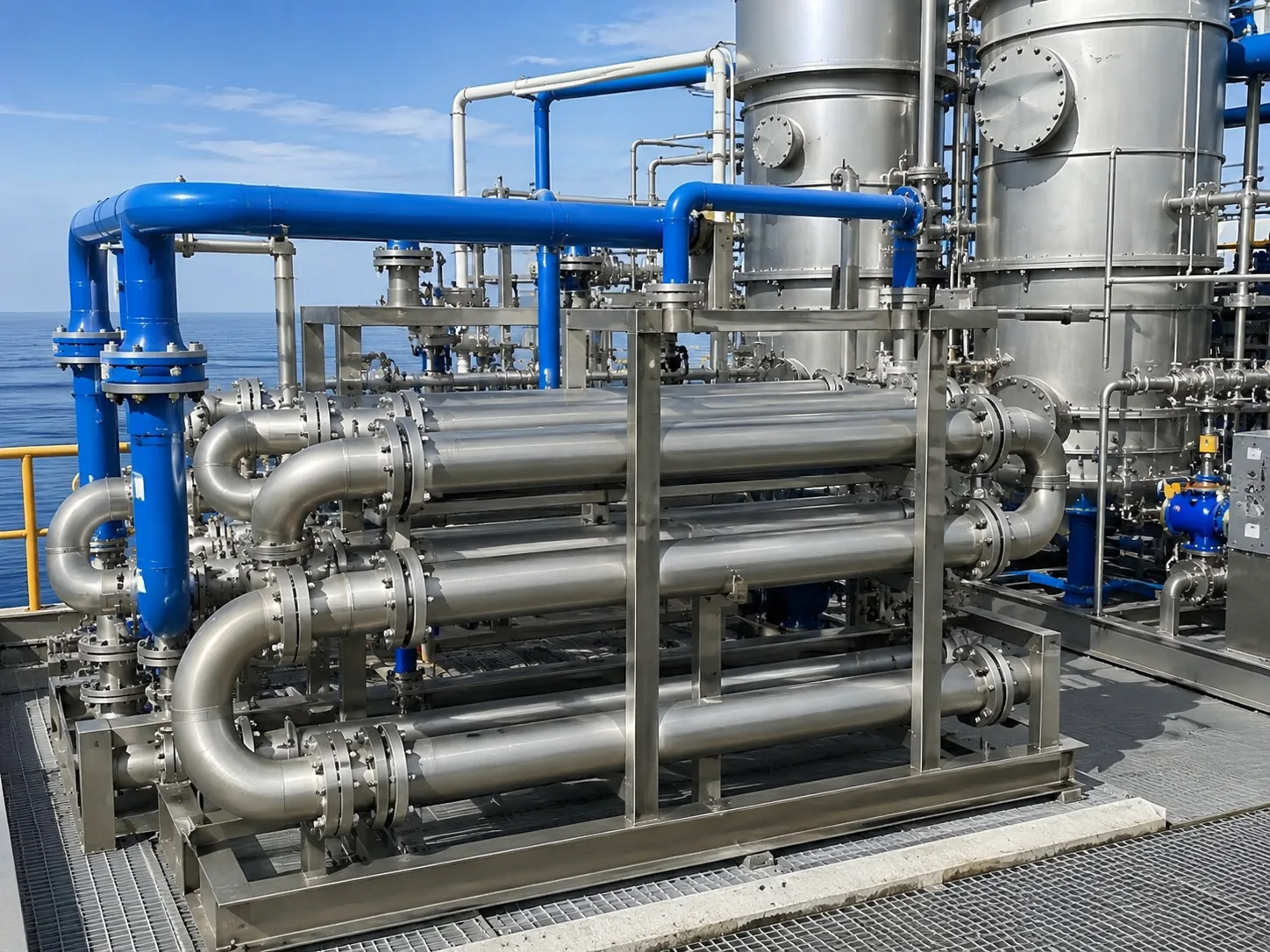
Seawater is an aggressive cooling medium for many engineering alloys, which is why titanium is widely considered for condensers, heat exchangers and thermal desalination equipment. For procurement teams, the important point is that “seawater service” describes an application, not a complete material specification.
Where titanium tubing appears in desalination
The International Titanium Association notes that titanium has substantial application in thermal desalination systems, including tubing, while its role in reverse-osmosis plants is more limited and component-specific. Thermal systems such as multi-stage flash and multi-effect distillation rely heavily on heat transfer, making tube material selection central to equipment reliability.
Condensers
Titanium tubes can be specified where seawater or brackish water creates a demanding cooling-water environment.
Evaporators
Thermal desalination equipment uses large heat-transfer surfaces where corrosion and fouling management matter.
Coolers
Process and auxiliary coolers may use titanium tubing when the cooling medium justifies the material choice.
Seawater piping components
Project material selection can extend beyond tubes to fittings, flanges and related titanium components.
Why titanium is considered for seawater heat transfer
TIMET technical literature highlights titanium's resistance to seawater corrosion and its use in seawater piping and heat exchangers. Its design handbook also notes that corrosion resistance can help limit corrosion-product buildup on heat-transfer surfaces. These characteristics can be attractive in lifecycle evaluations, but actual performance depends on the complete operating environment and equipment design.
Material selection still needs engineering review
Seawater chemistry is not identical at every site. Temperature, chlorination practice, flow regime, deposits, crevices, galvanic couples and startup/shutdown conditions can affect design decisions. The equipment/materials engineer should therefore confirm the selected titanium grade and any special design precautions.
What a desalination tube RFQ should contain
| RFQ section | Information to provide |
|---|---|
| Service | MED / MSF / condenser / cooler / seawater system and process-side medium |
| Material | Titanium grade required by project |
| Standard | Applicable tube/product specification |
| Construction | Seamless or welded, if specified |
| Dimensions | OD × wall × length, tube count |
| Inspection | NDT, pressure test, dimensional and visual requirements |
| Documentation | MTC, traceability, reports, third-party requirements |
| Logistics | Destination, packing, required shipment date |
Grade 2 as a common industrial reference
Commercially pure Grade 2 is widely used in seawater and heat-exchanger applications, but buyers should not treat it as a universal default. Read our Grade 2 titanium tube guide and confirm suitability against the project corrosion study.
Related products and applications
See titanium heat exchanger tube, industrial applications, titanium elbows and titanium weld-neck flanges. For a project quotation, use the RFQ page.
Long thin-wall exchanger tubes should be handled and stored to avoid bending, impact and contamination. Procurement documentation should make the required packaging and marking clear, especially for export shipments and large tube counts where mixed heat numbers or damaged bundles can delay fabrication.
Receiving and storage considerations
- Is the water natural seawater, brackish water or treated/chlorinated seawater?
- What are the normal and design temperatures?
- Which titanium grade has engineering approved?
- Does the exchanger specification require seamless or welded tube?
- Are there project-specific NDT, cleanliness or tube-end requirements?
- Does the owner require third-party inspection or a defined manufacturing record book?
Questions to clarify before ordering
Tube material is only one part of the exchanger system. Tube-sheet material, joining method, galvanic interfaces, water treatment and commissioning practices can influence performance. These are design responsibilities, but they affect procurement because they can create additional requirements for tube ends, cleanliness, dimensional control or documentation.
Interface details matter in titanium exchanger projects
For seawater heat-transfer equipment, material decisions are often evaluated over the equipment lifecycle. Procurement should therefore avoid comparing tube material only by initial cost per kilogram. The engineering evaluation may also consider corrosion allowance, cleaning, maintenance intervals, expected service life, shutdown risk and replacement complexity.
Think in terms of lifecycle, not only purchase price
Reference sources
References: International Titanium Association — seawater/desalination overview; TIMET Titanium Design and Fabrication Handbook.
Send your titanium tube RFQ
Send grade, standard, dimensions, quantity, inspection requirements and delivery destination. Drawings and BOM files can be sent by email or WhatsApp.
 Scan to chat on WhatsApp