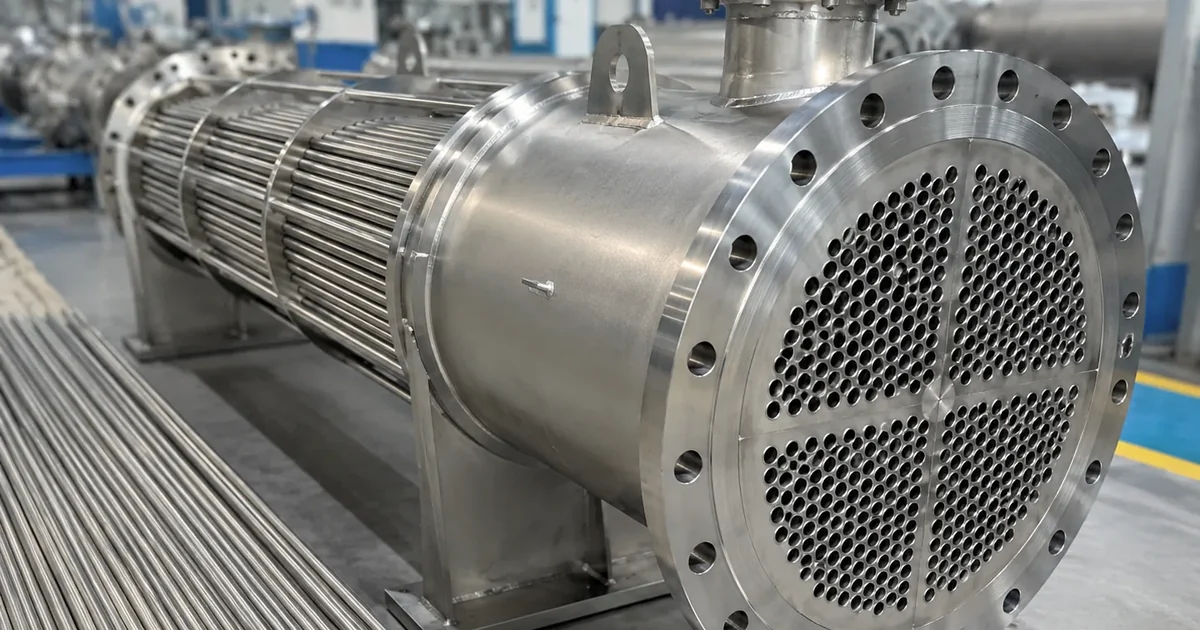
For seawater and chloride-rich heat exchangers, the material shortlist often moves beyond 316L stainless steel to titanium Grade 2 and Super Duplex 2507 / UNS S32750. Both materials can serve demanding projects, but they solve different engineering and procurement problems. Titanium is widely recognized for long-term seawater corrosion resistance and low density. Super Duplex 2507 offers much higher mechanical strength than conventional austenitic stainless steel together with strong resistance to pitting, crevice corrosion and chloride stress-corrosion cracking.
Titanium vs Super Duplex 2507: quick buyer comparison
| Procurement factor | Titanium Grade 2 | Super Duplex 2507 / UNS S32750 |
|---|---|---|
| Typical buyer objective | Long-life seawater and chloride heat-transfer service | High strength plus strong chloride-corrosion resistance |
| Common tube specification | ASTM B338 | ASTM A789/A789M or project-approved duplex tube specification |
| Density | Low; roughly 4.5 g/cm³ | Much higher; broadly similar to other stainless steels |
| Localized chloride corrosion | Excellent performance in many seawater services | Very strong pitting and crevice-corrosion resistance compared with 316L |
| Mechanical strength | Moderate compared with Super Duplex | Very high |
| Chloride stress-corrosion cracking | Strong resistance in many seawater applications | Designed to provide much better SCC resistance than common austenitic stainless steels |
| Fabrication control | Requires strict cleanliness and inert-gas shielding during welding | Requires tight heat-input and phase-balance control during welding and heat treatment |
| Typical project position | Corrosion-life driven option | Strength + corrosion + stainless-system option |
This table is a procurement overview. Final material selection must follow the purchaser's corrosion review, pressure design, code basis, fabrication capability and lifecycle objectives.
Why Super Duplex 2507 enters the seawater material shortlist
Super Duplex 2507 is commonly identified as UNS S32750. Its duplex ferritic-austenitic microstructure combines high chromium, molybdenum and nitrogen alloying with a balanced two-phase structure. The result is substantially higher strength than conventional austenitic stainless steels and strong resistance to localized corrosion and chloride stress-corrosion cracking.
This is why Super Duplex 2507 is widely considered for:
- desalination plants;
- offshore equipment;
- seawater piping systems;
- high-chloride process equipment;
- scrubbers;
- oil and gas service;
- high-pressure corrosive systems;
- selected heat exchangers and coolers.
Outokumpu lists UNS S32750 / 2507 among its super-duplex grades for desalination and extremely corrosive environments, which reflects its established position in high-chloride industrial design.
Why titanium remains a reference material for seawater heat exchangers
Commercially pure titanium, especially Grade 2, develops a stable protective oxide film and has a long industrial history in natural seawater, condensers, desalination and marine cooling equipment. For tube bundles exposed continuously to aerated seawater, that corrosion behavior can be more important than high mechanical strength.
Titanium is therefore commonly considered for:
- seawater heat exchangers;
- surface condensers;
- desalination equipment;
- marine coolers;
- coastal power plants;
- offshore cooling systems;
- chloride-rich industrial water.
For a dedicated application guide, see Titanium Tube for Desalination & Seawater Service.
Localized corrosion: where the comparison becomes important
In real heat exchangers, the most aggressive location is not always the bulk fluid. Tube-to-tubesheet interfaces, deposits, gasketed regions, stagnant zones and fouled surfaces can create locally concentrated chemistry and oxygen gradients.
The material review should therefore examine:
- chloride concentration;
- maximum operating temperature;
- pH;
- crevice geometry;
- fouling and deposits;
- flow velocity and stagnant zones;
- cleaning chemicals;
- shutdown chemistry;
- galvanic contact with adjacent materials.
Titanium and Super Duplex 2507 both address localized-corrosion risks much more seriously than conventional 316L, but they do so through different alloy systems and design assumptions.
Pitting and crevice corrosion: titanium vs 2507
Super Duplex 2507 is engineered for high pitting and crevice-corrosion resistance. Its chromium, molybdenum and nitrogen content gives it a significantly higher localized-corrosion margin than standard austenitic stainless steels.
Titanium Grade 2 approaches seawater service differently. Rather than relying on a high-alloy stainless passive film, titanium forms a very stable titanium-oxide film that performs extremely well in many aerated chloride environments.
For a purchaser, the decision should not be reduced to a single PREN number or a generic “seawater resistant” label. Consider the actual equipment geometry and service history. If the owner has prior failures with stainless materials in the same duty, titanium may deserve additional lifecycle weighting.
Mechanical strength: where Super Duplex 2507 has a major advantage
Super Duplex 2507 offers much higher yield and tensile strength than commercially pure titanium Grade 2. That can be important in pressure-containing systems, tube sheets, piping, structural components and designs where wall thickness is governed by mechanical load rather than only corrosion and heat transfer.
However, higher alloy strength does not mean the buyer can automatically reduce tube wall thickness. Any wall reduction is a design change that must consider:
- internal and external pressure;
- tube vibration;
- support spacing;
- erosion allowance;
- handling damage;
- tube expansion or welding;
- code minimum thickness;
- manufacturing tolerance.
Density and total bundle weight
Titanium is substantially lighter than stainless steel. That difference matters when an exchanger contains thousands of long tubes.
A lower-density tube material can affect:
- total bundle weight;
- lifting and handling;
- transport cost;
- support loads;
- installation planning;
- material cost calculated from total mass.
This is why comparing only USD/kg can be misleading. A titanium quotation with a higher unit price may not translate directly into the same percentage increase in complete bundle cost.
Thermal performance: do not compare material conductivity alone
Heat-exchanger performance depends on the total thermal circuit. Tube metal conductivity is only one resistance among several.
The overall heat-transfer coefficient also depends on:
- tube wall thickness;
- inside and outside film coefficients;
- fluid velocity;
- fouling resistance;
- tube diameter;
- surface condition;
- temperature difference;
- flow arrangement.
For this reason, a meaningful titanium-vs-2507 comparison should use the actual exchanger calculation with each material's approved wall thickness and fouling assumptions.
Fabrication risk: both materials require discipline
Titanium and Super Duplex are both technically weldable, but neither should be treated like ordinary carbon steel.
Titanium fabrication controls
- clean dedicated tooling;
- protection from iron contamination;
- high-quality inert-gas shielding;
- controlled weld-zone cleanliness;
- appropriate filler and procedure qualification.
Super Duplex 2507 fabrication controls
- controlled heat input;
- appropriate interpass temperature;
- balanced ferrite/austenite phase structure;
- correct filler selection;
- avoidance of harmful intermetallic phases;
- qualified welding and heat-treatment procedures.
For equipment procurement, evaluate the fabricator's process capability—not only the raw-material supplier's certificate.
ASTM standards: keep the material options technically separate
Titanium heat-exchanger tubing is commonly specified under ASTM B338, which covers seamless and welded titanium and titanium-alloy tubes intended for surface condensers, evaporators and heat exchangers.
Super Duplex 2507 tubing is commonly purchased under ASTM A789/A789M or another approved ferritic-austenitic stainless tube specification depending on the project. ASTM A789/A789M covers seamless and welded ferritic/austenitic stainless steel tubing for general corrosion-resistant service with particular emphasis on resistance to stress-corrosion cracking.
| Material option | Common purchasing standard | What buyer must still define |
|---|---|---|
| Titanium Grade 2 | ASTM B338 | Grade, edition, seamless/welded route, OD, wall, length, test and documentation |
| Super Duplex 2507 | ASTM A789/A789M or project-specific standard | UNS S32750, edition, construction, heat treatment, dimensions, testing and documentation |
For titanium purchasing details, see ASTM B338 Titanium Tube RFQ Guide.
Seawater desalination: which material has the stronger procurement case?
Both materials appear in desalination and seawater systems, but the preferred option depends on the exact zone of the plant.
| Project condition | Material direction to review |
|---|---|
| Continuous seawater condenser / cooler | Titanium often deserves strong consideration |
| High-pressure seawater piping / structural service | Super Duplex 2507 often deserves strong consideration |
| Concentrated hot brine | Detailed materials review; titanium, Super Duplex or nickel alloy may be compared |
| Existing stainless tube failures | Review titanium and root cause before repeating the same alloy strategy |
| Weight-sensitive exchanger bundle | Titanium may offer a significant mass advantage |
| High-strength integrated stainless system | Super Duplex may simplify the materials family and structural design |
Initial material price vs lifecycle economics
Super Duplex and titanium are both premium materials compared with conventional stainless steel. The correct commercial comparison should include more than raw tube price.
Evaluate:
- total installed tube weight;
- wall thickness;
- expected service life;
- inspection frequency;
- tube plugging rate;
- retubing cost;
- planned shutdown duration;
- risk of product or process contamination;
- spare material requirements;
- fabrication qualification;
- packing and freight;
- project design life.
When titanium is more likely to be the preferred option
Titanium may deserve stronger consideration when:
- natural seawater is the continuous cooling medium;
- localized-corrosion failure must be minimized;
- the exchanger is difficult or costly to retube;
- long uninterrupted operating campaigns are required;
- bundle weight matters;
- the owner has successful titanium service history;
- maintenance access is poor;
- previous stainless-based solutions experienced recurring corrosion.
When Super Duplex 2507 may be more attractive
Super Duplex 2507 may be attractive when:
- high mechanical strength is a major design driver;
- the project already uses Super Duplex piping or pressure components;
- the fabricator has proven Super Duplex welding capability;
- chloride resistance must be much stronger than 316L;
- stainless-system compatibility is important;
- the approved corrosion review accepts S32750;
- wall-thickness or structural requirements favor the higher-strength alloy.
What about Alloy 625 or Hastelloy C276?
If the process combines chlorides with strong acids, highly reducing conditions, oxidizing contaminants or elevated-temperature mixed chemistry, the actual comparison may extend beyond titanium and Super Duplex.
Nickel alloys such as Alloy 625 or Hastelloy C276 can become relevant where the chemical service exceeds the comfortable design envelope of stainless steels or titanium. Your RFQ should therefore identify the process medium accurately instead of labeling every application simply as “seawater.”
Related product pages: Inconel 625 Tube and Hastelloy C276 Tube.
Titanium vs Super Duplex 2507 RFQ checklist
| RFQ field | What to provide |
|---|---|
| Application | Heat exchanger, condenser, desalination unit, cooler or replacement bundle |
| Process medium | Natural seawater, brine, cooling water or chemical stream |
| Chloride concentration | Normal and maximum value |
| Temperature | Operating, maximum and design temperature |
| pH | Normal range and abnormal conditions if relevant |
| Pressure | Operating and design pressure |
| Material option | Titanium Grade 2, UNS S32750, or approved alternate quotation |
| Tube standard | ASTM B338, A789/A789M or approved project specification |
| Construction | Seamless / welded / approved alternatives |
| Dimensions | OD × wall thickness × finished length |
| Quantity | Pieces by size plus approved spare quantity |
| Inspection | NDT, pressure test, PMI, dimensional inspection and witness points |
| Documents | MTC, heat traceability, inspection reports and TPI requirements |
| Packing | Export crate/bundle, end protection, identification and lifting limitations |
| Delivery | Country, port, incoterm and required arrival date |
How to request two alternate quotations
ASTM B338 Grade 2 · OD ___ mm × WT ___ mm × L ___ mm · ___ pcs · seamless/welded ___ · inspection ___
Option B — Super Duplex:
UNS S32750 / project-approved ASTM A789 basis · OD ___ mm × WT ___ mm × L ___ mm · ___ pcs · seamless/welded ___ · inspection ___
If the approved wall thickness differs between the two materials, do not force both suppliers to quote the same wall merely for commercial convenience. Engineering should establish the correct design basis first.
Supplier evaluation questions
Before placing the order, ask whether the supplier can support:
- the exact grade and product standard;
- fixed-length tube production;
- thin-wall dimensional control;
- required seamless or welded route;
- NDT and pressure-test scope;
- material traceability;
- PMI where required;
- EN 10204 / MTC documentation if specified;
- third-party inspection;
- export packing for long tubes;
- technical deviation control.
For a broader vendor checklist, see Titanium Tube Supplier Selection Guide.
Frequently asked questions
Is titanium better than Super Duplex 2507 for seawater?
Not universally. Titanium is a very strong choice for continuous seawater heat-transfer service, while 2507 offers high strength plus strong chloride-corrosion resistance. The final selection depends on the entire design and lifecycle case.
What is UNS S32750?
UNS S32750 is the common designation for Super Duplex 2507, a high-strength ferritic-austenitic stainless steel designed for demanding chloride and corrosive environments.
Which material is lighter?
Titanium is substantially lighter. For large tube bundles, that can materially affect total weight, handling, freight and structural loads.
What standards are commonly used?
ASTM B338 is common for titanium heat-exchanger tubes. Duplex and Super Duplex tubing is commonly purchased under ASTM A789/A789M or another project-approved specification.
Can suppliers quote both options?
Yes, if engineering permits alternate materials. Each quotation should use a complete approved design basis, including the correct wall thickness, standard, inspection and documentation scope.
Related titanium tube procurement guides
- Titanium Heat Exchanger Tube
- Titanium Heat Exchanger Tubes Buyer Guide
- Titanium vs 316L Stainless Steel Heat Exchanger Tubes
- Grade 2 vs Grade 12 for Chloride Service
- Titanium Tube for Desalination & Seawater Service
- Titanium Condenser Tubes for Power Plants
- ASTM B338 Titanium Tube RFQ Guide
Reference sources
Titanium tube standard: ASTM B338-17(2026) — Seamless and Welded Titanium and Titanium Alloy Tubes for Condensers and Heat Exchangers.
Super Duplex application and corrosion context: Outokumpu Forta Duplex Stainless Steels — Forta SDX 2507 / UNS S32750.
Duplex tubing standard basis: ASTM A789/A789M — Seamless and Welded Ferritic/Austenitic Stainless Steel Tubing for General Service. Use the project-approved edition and specification at the time of purchase.
Request a quote for titanium heat exchanger tubes
Send your process medium, chloride level, operating temperature, OD × wall × length, quantity, required standard and inspection scope. If your engineering team is comparing titanium with Super Duplex, attach the exchanger datasheet or approved tube schedule.
 Scan to chat on WhatsApp