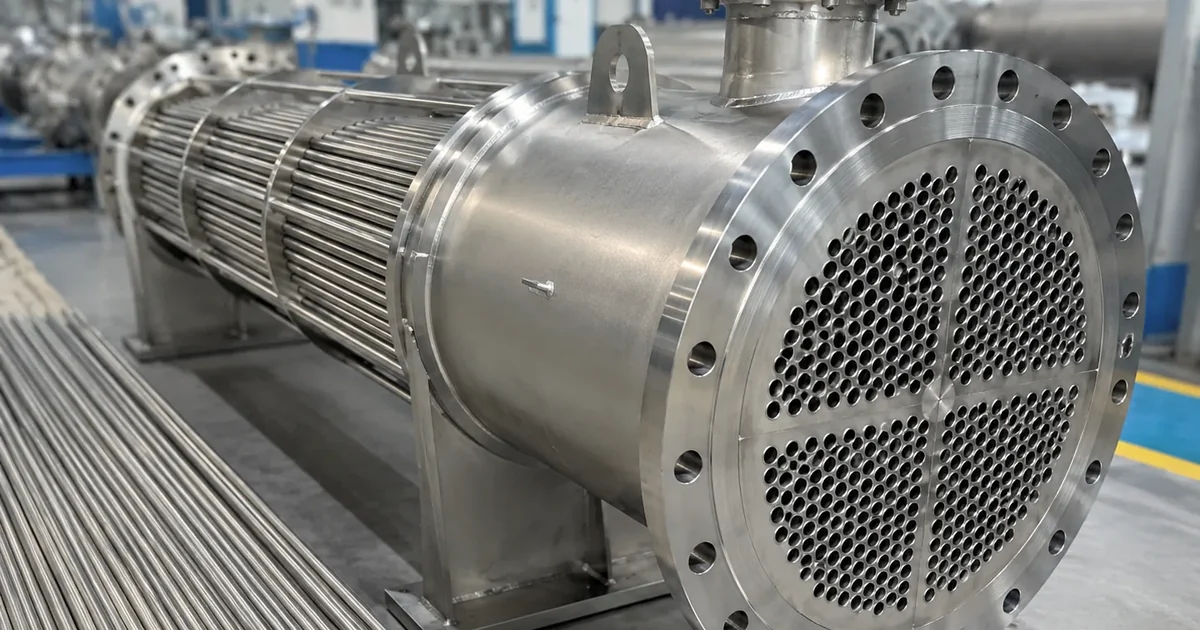
Titanium heat exchanger tubes are purchased as precision heat-transfer components, not as generic titanium pipe. The commercial risk in an RFQ is therefore not only choosing the wrong grade. It is allowing suppliers to quote different tube routes, dimensions, testing scopes, document packages or length assumptions while the buyer compares only unit price.
Why heat exchanger tube RFQs need more detail than “titanium tube”
A heat exchanger tube becomes part of an equipment system whose tube sheet, tube-to-tubesheet joint, thermal duty, process medium, cleaning method and inspection plan have already imposed constraints. A supplier cannot reliably infer those constraints from the words “titanium tube.” For this reason, the purchasing package should connect the tube order to the approved equipment drawing, bill of materials or tube schedule whenever one exists.
ASTM describes B338 as a specification for seamless and welded titanium and titanium-alloy tubes intended for surface condensers, evaporators and heat exchangers. That makes it a common starting point for industrial RFQs. However, the standard does not replace the purchaser's project specification. Buyers still have to define the exact product they need.
1. Start with the governing standard and the project-approved edition
For many condenser and heat-exchanger tube purchases, the RFQ references ASTM B338. Write the standard explicitly and, where the project controls the edition, state that edition exactly. Avoid writing “latest standard” when the engineering package already identifies a specific edition.
The same rule applies when an owner, EPC contractor or equipment manufacturer adds supplementary requirements. A quotation should identify those additions as part of the technical scope rather than treating them as optional after award. This is especially important when special NDT, tolerance, documentation or third-party inspection requirements affect manufacturing cost and lead time.
2. Define the titanium grade instead of asking the supplier to choose
Grade 2 titanium heat exchanger tube is frequently encountered in industrial procurement, but “commonly used” is not the same as “correct for every service.” Grade selection must follow the approved design conditions, process chemistry and project materials specification. If the drawing states Grade 2, the RFQ should state Grade 2. If another commercially pure or alloyed grade is required, keep that designation consistent across the drawing, BOM, RFQ and purchase order.
Do not let a low-price quotation quietly substitute another grade. Any proposed deviation should be listed separately and accepted only through the purchaser's engineering process.
3. State seamless or welded construction when the project controls it
ASTM B338 covers both seamless and welded tube. From a procurement perspective, this means two quotes can both reference B338 while still representing different manufacturing routes. That is why the RFQ should specify seamless titanium tube, welded titanium tube, or an approved alternative only when the project permits that choice.
There is no useful universal rule that one route is always superior for every heat exchanger. The decision is project-specific and can be influenced by engineering requirements, size range, availability, inspection, tube quantity and commercial considerations. For a side-by-side purchasing view, see our seamless vs. welded titanium tube buyer guide.
4. Use OD × wall thickness × length, with units on every value
Heat exchanger tubing should be quoted with precise dimensions. A good line item states the outside diameter, wall thickness and length in one consistent unit system. If tubes are fixed length, state whether the length is finished length and include the project tolerance where required. If the tube ends have special preparation, mark it on the drawing or line item.
Length deserves special attention because it affects material yield, straightening, packing and freight. A supplier quoting random lengths is not quoting the same scope as a supplier quoting thousands of fixed-length tubes for one bundle.
| RFQ field | Example purchasing entry | What it prevents |
|---|---|---|
| Product | Titanium heat exchanger tube | Confusion with general pipe or structural tube |
| Standard | ASTM B338, project-approved edition | Different technical baselines |
| Grade | Grade 2, or as drawing requires | Unapproved material substitution |
| Construction | Seamless / welded / per approved spec | Different manufacturing routes in competing bids |
| Dimensions | OD × WT × fixed length | Incorrect weight, fit or tube-sheet assumptions |
| Quantity | Pieces + total meters where useful | Ambiguous order size and freight basis |
| Testing | Method, extent and report requirement | Vague “full inspection” pricing |
| Documents | MTC, traceability, NDT/pressure reports as required | Missing turnover documentation |
5. Connect tube dimensions to the tube sheet and equipment drawing
For replacement bundles and custom exchangers, purchasing should verify that the tube OD, wall and finished length are taken from an approved drawing or controlled measurement. The tube-to-tubesheet method—such as expansion, welding, or a project-specific combination—can influence dimensional and end-condition requirements. The tube supplier does not design that joint unless the contract explicitly includes engineering responsibility.
When the project involves a complete unit rather than tube-only supply, our Power Plant Titanium Condenser Tube Guide →titanium shell & tube heat exchanger and titanium heat exchanger product pages provide a better RFQ starting point.
6. Write inspection requirements as measurable deliverables
“Full inspection” is not a procurement specification. State the required nondestructive test or pressure test, the extent of testing, the acceptance basis, witness or hold points, and whether a report is required. ASTM B338 itself contains testing requirements that vary with tube condition, while project specifications can add more.
If third-party inspection is required, include it at RFQ stage. The difference between document review, witness inspection and a formal hold point can change the production schedule. Likewise, if dimensional inspection must be reported for every tube or only on a sampling plan, say so before quotation.
7. Define the quality document package before comparing price
Industrial buyers commonly need more than the physical tubes. Depending on the project, the turnover package may include a material test certificate, heat or lot traceability, dimensional inspection records, NDT or pressure-test reports, packing list, certificate of origin, inspection release note or other owner-required documents.
These items are part of the deliverable. If one supplier has priced a full document dossier and another has priced tube only, the bids are not directly comparable. Use a technical bid tabulation to show included items, exclusions and deviations before commercial negotiation.
8. Packing is part of tube quality
Long, relatively thin-wall tubes can be damaged by poor handling even when the material itself is correct. The RFQ should therefore identify bundle protection, end protection where required, moisture control or export packing expectations, marking, lifting restrictions and any maximum package size imposed by the project.
For international shipments, also align the packing list with the line-item identification used on the purchase order. That makes receiving inspection and bundle segregation faster when several diameters or lengths arrive together.
9. Compare suppliers on the same technical basis
A practical comparison matrix should cover more than price per kilogram or price per meter. Check the standard and edition, grade, construction, dimensions, quantity basis, testing, document package, packing, lead time, incoterm, validity and stated deviations. If a supplier proposes an alternative construction or inspection plan, keep it as a separate option rather than mixing it into the compliant bid.
This step is especially important when sourcing from a new titanium heat exchanger tube supplier. The cheapest line price can become the most expensive option if the final order later requires re-testing, document reconstruction, re-packing or replacement of out-of-scope material.
A practical RFQ checklist for titanium heat exchanger tubes
Material
Grade, product standard, approved edition, manufacturing route and any supplementary project specification.
Dimensions
OD, wall thickness, fixed/random length, length tolerance, end condition and drawing reference where applicable.
Quantity
Pieces, total meters or weight; identify each size as a separate line item and note permitted overage/shortage only if accepted.
Inspection
NDT/pressure testing, dimensional inspection, sampling or 100% extent, witness points and acceptance criteria.
Documents
MTC, traceability, test reports, dimensional report, packing list and any owner/EPC document index.
Commercial
Delivery destination, required date, incoterm, packing basis, currency and quotation validity.
For a broader RFQ template, use our titanium tube RFQ buyer checklist. If your requirement is specifically for the tube product, review the Titanium Heat Exchanger Tube page and send the approved tube schedule with your inquiry.
Frequently asked questions
What information should a titanium heat exchanger tube RFQ include?
At minimum, state grade, standard/edition, construction if controlled, OD, wall, length, quantity, testing, documentation, packing and destination. Add the approved drawing or tube schedule when available.
Is ASTM B338 enough for a complete quotation?
No. It establishes a core product specification, but the buyer still needs to define project dimensions, quantity, inspection, documentation and any owner/EPC additions.
Is Grade 2 commonly used?
Yes, Grade 2 is frequently specified, but the final grade must follow the approved process and equipment materials specification.
Seamless or welded?
Use the construction required by the approved project. If either route is permitted, ask suppliers to identify the proposed route clearly so quotations remain comparable.
What documents should be requested?
Typical requirements may include MTC, heat/lot traceability, dimensional records and applicable NDT or pressure-test reports. Define the exact dossier in the RFQ.
Reference source
Reference: ASTM B338 — Standard Specification for Seamless and Welded Titanium and Titanium Alloy Tubes for Condensers and Heat Exchangers. The purchaser's approved standard edition, equipment drawing and technical specification remain controlling.
Send your titanium heat exchanger tube RFQ
Send grade, ASTM standard/edition, OD, wall thickness, length, quantity, construction, inspection and document requirements. Drawings, tube schedules and BOM files can be sent by email or WhatsApp.
 Scan to chat on WhatsApp