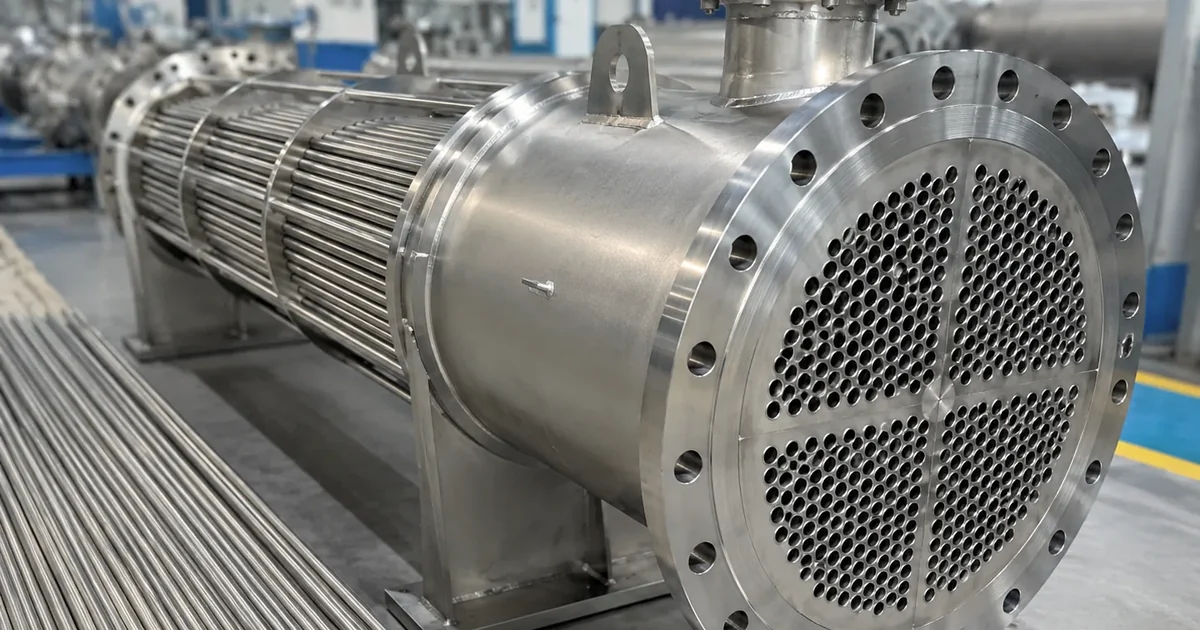
When a buyer asks for a titanium tube for chloride service, the real question is not simply whether titanium resists chlorides. The procurement decision depends on the complete service environment: chloride concentration, temperature, pH, oxidizing or reducing conditions, deposits, crevices, tube-sheet geometry, cleaning chemistry and the consequences of leakage. Grade 2 and Grade 12 titanium tube can both appear in heat-transfer and chemical-service projects, but they should not be treated as interchangeable commodities.
Grade 2 vs Grade 12 titanium tube: quick comparison
| Selection point | Grade 2 titanium | Grade 12 titanium |
|---|---|---|
| UNS designation | R50400 | R53400 |
| Material family | Commercially pure titanium | Low-alloy titanium with Ni + Mo additions |
| Typical buyer rationale | Broad industrial corrosion resistance, availability, formability and weldability | Additional strength and improved margin in selected crevice / chloride / reducing environments |
| Heat-exchanger tube standard | ASTM B338 when specified | ASTM B338 when specified |
| Seamless / welded | Project specification controls | Project specification controls |
| Procurement approach | Use when approved by project materials selection | Use when Grade 12 is explicitly selected or approved as a deviation |
This table is a procurement comparison, not a universal corrosion limit chart. Real material selection must be based on actual process conditions and the purchaser's engineering specification.
What ASTM B338 says about Grade 2 and Grade 12 tubing
ASTM B338 is a primary specification for seamless and welded titanium and titanium-alloy tubing intended for surface condensers, evaporators and heat exchangers. The current ASTM listing, ASTM B338-17(2026), includes both Grade 2 and Grade 12. ASTM identifies Grade 2 as unalloyed titanium, UNS R50400, and Grade 12 as titanium alloy UNS R53400 containing nominal additions of molybdenum and nickel.
For purchasing, this distinction matters because “ASTM B338 titanium tube” is incomplete. The RFQ must still state:
- titanium grade;
- approved ASTM/ASME edition;
- seamless or welded construction;
- outside diameter;
- wall thickness;
- finished length;
- quantity;
- testing and inspection;
- certificate requirements;
- project-specific supplementary requirements.
See our dedicated ASTM B338 Titanium Tube RFQ Guide for a line-by-line purchasing checklist.
Why Grade 2 is widely used in chloride-containing systems
Grade 2 titanium is one of the most commonly purchased industrial titanium grades. Its usefulness in many chloride-containing environments comes from the stable passive oxide film that forms on the surface. For buyers, Grade 2 also offers a practical combination of corrosion resistance, fabrication characteristics and supply availability.
Typical project contexts may include:
- seawater heat exchangers;
- surface condensers;
- desalination systems;
- industrial cooling water;
- chemical heat exchangers;
- evaporators;
- selected chlorine and hypochlorite-related equipment;
- process equipment where the approved materials specification calls for commercially pure titanium.
However, “chloride resistant” should never be interpreted as “immune under every chloride condition.” Tight crevices, deposits, reducing chemistry, elevated temperature, unusual contaminants and improper galvanic or cathodic-protection conditions can change the corrosion mechanism. The actual process envelope must remain the basis of material selection.
For Grade 2 heat-transfer procurement, see Grade 2 Titanium Tube for Heat Exchangers.
What makes Grade 12 different?
Grade 12 is a low-alloy titanium grade with small additions of molybdenum and nickel. ASTM B338 identifies it as approximately Ti-0.3Mo-0.8Ni, UNS R53400. Those additions increase strength compared with commercially pure Grade 2 and were developed to improve performance in selected industrial corrosion environments.
Materials references commonly discuss Grade 12 in connection with improved resistance to crevice corrosion and under-deposit attack in chloride-containing environments, particularly when temperature and local chemistry become more severe. This makes Grade 12 relevant to chemical plants, heat exchangers, hot brine systems and other corrosion-critical equipment where Grade 2 may not provide enough design margin.
That does not mean Grade 12 is automatically the “better” purchase. If Grade 2 already satisfies the approved design conditions, changing to Grade 12 may increase material cost, complicate welding-procedure qualification or create a deviation from the owner's material specification without adding useful project value.
Hot brine and crevice conditions: why geometry matters
A buyer can focus too much on bulk chloride concentration and overlook the geometry of the equipment. A heat exchanger may contain narrow tube-to-tubesheet interfaces, gasketed joints, deposits, stagnant zones and other locations where the local chemistry can differ significantly from the main process stream.
In these confined locations, oxygen depletion and concentration effects can create a more aggressive environment than the bulk solution. For that reason, material selection for hot chloride and brine service should consider:
- maximum operating and design temperature;
- bulk chloride concentration;
- expected concentration under deposits;
- pH and possible local acidification;
- crevice geometry;
- flow and stagnation;
- scaling or fouling tendency;
- cleaning and shutdown chemistry;
- galvanic contact with other metals.
If the service is severe enough for Grade 12 to be considered, provide these conditions to the equipment designer or materials engineer instead of selecting the alloy only from a general supplier chart.
Grade 2 or Grade 12 for seawater heat exchangers?
For many conventional seawater heat exchangers, Grade 2 is a familiar and widely specified titanium grade. A buyer should therefore resist the idea that every seawater project needs an alloyed grade.
Grade 12 becomes more relevant when the seawater or brine system includes additional severity: higher temperature, concentrated brine, deposits, restrictive crevices, process contamination or other service features identified by the materials review.
If your project is primarily seawater or desalination service, also review: Titanium Tube for Desalination & Seawater Service.
Grade 2 or Grade 12 for chemical heat exchangers?
Chemical heat exchangers require more information than a seawater duty because the process stream may contain acids, oxidizers, reducing species, chlorides, impurities and cleaning chemicals at changing concentrations.
Before requesting a quotation, provide:
Process medium
List the principal chemicals and relevant impurities instead of writing only “chemical service.”
Concentration
State normal and maximum concentration ranges, including possible evaporation or concentration effects.
Temperature
Give normal operating, maximum operating and design temperatures where available.
pH / redox conditions
Provide process pH and information on reducing or oxidizing conditions when material selection depends on them.
Geometry
Identify tube-sheet joints, stagnant zones, deposits or other likely crevice locations.
Cleaning chemistry
Cleaning and shutdown solutions can expose the tube to a different environment than normal production.
Do not use chloride concentration as the only selection rule
Search results often encourage buyers to look for a single chloride ppm limit. That is rarely enough for a real industrial purchasing decision. Titanium performance is influenced by temperature, pH, oxygen availability, impurities, flow, deposits and geometry. Two systems with the same chloride concentration can therefore present different material risks.
A more reliable RFQ describes the full service envelope and asks the supplier to quote the specified grade, while any material recommendation remains subject to purchaser or engineering approval.
What about fluoride contamination?
Fluoride-containing environments deserve separate attention because fluorides can destabilize titanium's protective oxide film under certain conditions. If hydrofluoric acid, fluoride salts or fluoride-bearing cleaning chemicals can be present, do not rely on a general “titanium resists chlorides” statement.
The RFQ or materials review should identify fluoride concentration, pH, temperature and exposure duration. This is a case where the chemistry may matter more than the chloride level.
Seamless vs welded Grade 2 and Grade 12 titanium tube
Grade selection and manufacturing route are separate decisions. ASTM B338 covers both seamless and welded tubing, so a buyer should not assume that specifying Grade 12 automatically means seamless construction.
If the project requires seamless tubing, state it explicitly. If welded tubing is allowed, require the supplier to identify the proposed route and all associated inspection requirements.
Related product pages: Titanium Seamless Tube and Titanium Welded Tube.
Mechanical strength can also influence the grade decision
Grade 12 offers higher minimum strength than Grade 2 under common specifications. That can be useful in some engineered components, but higher strength alone should not drive a heat-exchanger tube substitution. Tube wall, pressure design, tube-sheet joint, forming behavior, welding procedure and code compliance must all remain consistent with the approved equipment design.
If the project team is considering a thinner wall because of higher alloy strength, that is a design change—not a purchasing shortcut.
Procurement risk: “upgrade to Grade 12” is still a deviation
Suppliers sometimes describe Grade 12 as an upgrade from Grade 2. Commercially that sounds simple, but engineering procurement needs stricter control.
If a drawing, datasheet or purchase specification calls for Grade 2, a proposed Grade 12 supply should be listed as a technical deviation. The purchaser can then review:
- corrosion suitability;
- code and design allowables;
- welding consumables and procedures;
- forming or expansion procedure;
- tube-sheet compatibility;
- inspection and documentation;
- material availability and delivery;
- commercial impact.
The same principle applies in reverse. A supplier must not downgrade a specified Grade 12 tube to Grade 2 because the service “looks similar.”
Grade 2 vs Grade 12 titanium tube RFQ checklist
| RFQ field | What to specify | Why it matters |
|---|---|---|
| Grade | Grade 2 or Grade 12 exactly as approved | Prevents unapproved substitution |
| Standard | ASTM B338 / ASME SB-338 and approved edition where applicable | Defines the product specification basis |
| Construction | Seamless or welded | Prevents technically different quotations |
| Dimensions | OD × wall thickness × finished length | Controls weight, fit-up and manufacturing scope |
| Quantity | Pieces or total length by size | Required for production and price calculation |
| Process medium | Chemicals, chloride/brine concentration and impurities | Supports materials review |
| Temperature | Operating, maximum and design temperature | Critical for corrosion and mechanical assessment |
| pH / process condition | Normal and upset conditions if known | Helps identify reducing or severe environments |
| Inspection | NDT / pressure test / dimensional / visual requirements | Defines acceptance scope |
| Documents | MTC, traceability, reports and TPI requirements | Prevents turnover-document gaps |
| Packing | Export packing, end protection and marking | Reduces transport and receiving risk |
| Destination | Country, port or project site | Allows realistic logistics quotation |
A better way to request a quotation
ASTM B338 Grade 12 Titanium Heat Exchanger Tube
Construction: Seamless / Welded as project specification
OD: ___ mm · WT: ___ mm · Length: ___ mm
Quantity: ___ pcs
Service: chloride-containing process / hot brine
Chloride concentration: ___
Operating / design temperature: ___ / ___ °C
pH: ___
Inspection: ___
MTC / TPI: ___
Destination: ___
This format gives the supplier enough information to quote the requested material and identify obvious specification gaps without taking over the purchaser's engineering responsibility.
How international buyers should compare quotations
For Grade 2 versus Grade 12 tubing, comparing only USD/kg can be misleading. Normalize each quotation against the same technical basis:
- same alloy grade;
- same ASTM/ASME edition;
- same seamless/welded route;
- same OD, wall and finished length;
- same quantity tolerance;
- same testing level;
- same documentation;
- same packing;
- same incoterm and delivery destination.
If one supplier includes inspection, fixed-length control and export crates while another excludes them, the cheaper line price may not be the cheaper installed project cost.
Related titanium tube procurement guides
- Titanium Heat Exchanger Tube
- Titanium Heat Exchanger Tubes Buyer Guide
- ASTM B338 Titanium Tube RFQ Guide
- Grade 2 Titanium Tube for Heat Exchangers
- Titanium Tube for Desalination & Seawater Service
- Titanium Condenser Tubes for Power Plants
- How to Specify a Titanium Tube RFQ
Frequently asked questions
Is Grade 2 titanium suitable for chloride service?
Grade 2 is widely used in many seawater and chloride-containing services when the approved design conditions are within its suitable operating envelope. Temperature, pH, crevices, deposits and contaminants still need to be reviewed.
When should Grade 12 be considered?
Grade 12 may be considered when the materials review requires additional margin in more demanding chloride, hot-brine, crevice, under-deposit or mildly reducing conditions.
Does ASTM B338 include Grade 12?
Yes. ASTM B338 includes Grade 12, UNS R53400, for titanium and titanium-alloy condenser and heat-exchanger tubing.
Can Grade 12 replace Grade 2 automatically?
No. A grade change should be treated as a technical deviation and reviewed against the approved design, code, fabrication and service requirements.
What should be included in a chloride-service RFQ?
Include grade, standard, construction, dimensions, quantity, medium, concentration, operating/design temperature, pH, inspection, documentation, packing and destination.
Reference basis
ASTM reference: ASTM B338-17(2026) — Seamless and Welded Titanium and Titanium Alloy Tubes for Condensers and Heat Exchangers. ASTM identifies Grade 2 as UNS R50400 and Grade 12 as UNS R53400, Ti-0.3Mo-0.8Ni.
Corrosion-service context: Materials-industry references describe Grade 12 as offering improved resistance to selected crevice and under-deposit corrosion conditions compared with commercially pure titanium. Project-specific materials selection remains the responsibility of the purchaser and engineering team.
Request a quote for Grade 2 or Grade 12 titanium tube
Send grade, standard, OD × wall × length, quantity and inspection requirements. For chloride or chemical service, include process medium, concentration, temperature and pH when available.
 Scan to chat on WhatsApp