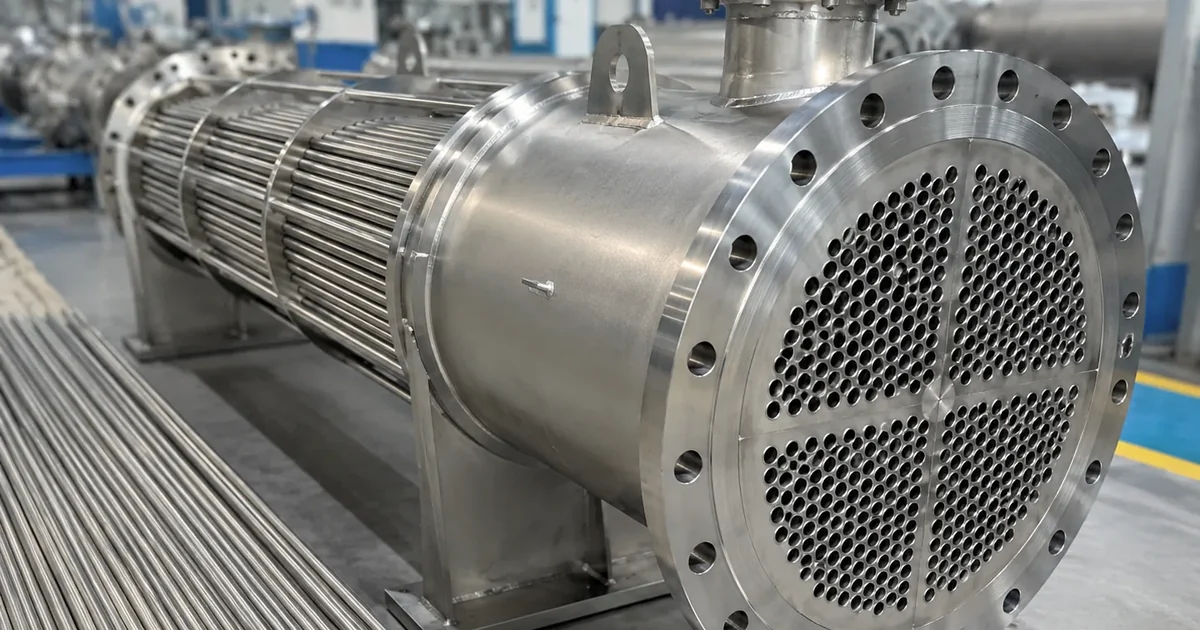
Titanium condenser tubes are commonly purchased for surface condensers and seawater-cooled heat-transfer systems where the buyer needs a controlled combination of corrosion resistance, dimensional accuracy, tube-sheet compatibility, inspection and long-term operating reliability. In a power-plant or condenser-retubing RFQ, the tube price is only one part of the decision. A quotation is not truly comparable unless every supplier is pricing the same grade, standard, manufacturing route, OD, wall thickness, finished length, testing, document package and packing basis.
Why titanium condenser tubes are specified in seawater-cooled power plants
A surface condenser may contain thousands of long, relatively thin-wall tubes exposed to cooling water for extended operating periods. Where the cooling medium is seawater or another chloride-containing water source, tube material selection becomes a lifecycle and reliability decision rather than a simple raw-material comparison.
Titanium is used in condenser service because its passive oxide film provides strong resistance in many seawater environments. This is why titanium surface condenser tubing appears in power generation, coastal plants, desalination facilities and other heat-rejection systems using seawater cooling. However, titanium does not eliminate the need for correct equipment design, water-box management, tube support, cleaning practice, cathodic-protection review or inspection. The tube must still be specified as part of the complete condenser system.
If your application is primarily desalination rather than power generation, see our separate guide: Titanium Tube for Desalination & Seawater Service. Keeping these applications on separate pages helps buyers find information that matches the actual procurement context.
ASTM B338 and titanium tubes for surface condensers
ASTM B338 is a core product specification for seamless and welded titanium and titanium-alloy tubing intended for surface condensers, evaporators and heat exchangers. For power-plant condenser procurement, it is therefore a logical technical baseline when the project specification calls for ASTM B338 tubing.
The standard alone does not complete the RFQ. Buyers must still define the approved edition, titanium grade, tube construction, dimensions, quantity, tolerances, testing, documentation and project-specific requirements. As of 2026, ASTM lists B338-17(2026) as the active version, but a project may contractually require a different edition. The purchase order should follow the project-approved specification rather than silently changing editions.
For a deeper standard-focused checklist, see: ASTM B338 Titanium Tube RFQ Guide.
Grade 2 titanium condenser tube: common does not mean automatic
Grade 2 titanium condenser tube is frequently encountered in industrial heat-transfer procurement. It combines commercially pure titanium chemistry with useful formability, weldability and corrosion resistance for many condenser applications. This is one reason Grade 2 is often considered for seawater-cooled surface condensers.
The purchasing team should not select Grade 2 merely because it is widely available. The final grade must follow the approved materials selection for the actual condenser duty. Cooling-water chemistry, temperature, contaminants, system design, galvanic conditions and owner requirements all matter. If the drawing specifies Grade 2, maintain that designation consistently across the BOM, RFQ, supplier quotation and purchase order. If a supplier proposes another grade, treat it as a technical deviation requiring engineering approval.
For more material-selection context: Grade 2 Titanium Tube for Heat Exchangers.
New condenser vs. condenser retubing: the RFQ is different
A new condenser project normally has controlled design drawings, tube sheets, tube-support spacing, tube-to-tubesheet joint details and a defined material specification. A condenser retubing or replacement project can be more complicated because the purchaser may be working from older drawings, field measurements, previous repair records and operating history.
For replacement titanium condenser tubes, confirm the required finished length from an approved drawing or a controlled measurement procedure. Do not assume that a nominal condenser model number gives enough information to manufacture the replacement tubes. During a long service life, previous repairs, tube-sheet work, bundle modifications or original manufacturing tolerances can create differences that matter during installation.
| RFQ item | New condenser project | Retubing / replacement project |
|---|---|---|
| Drawing basis | Approved equipment drawing and tube schedule | Approved legacy drawing plus verified field data where required |
| Tube length | Defined by current condenser design | Verify finished replacement length before order |
| Tube end condition | Per new tube-to-tubesheet design | Match approved repair / retubing procedure |
| Quantity | Bundle quantity plus approved spare allowance | Replacement count plus realistic installation spares |
| Inspection records | Project ITP and supplier documentation | May also reference historical ECT / tube mapping information |
| Packing sequence | By bundle, size or erection sequence | May need outage- and installation-oriented identification |
Specify OD × wall thickness × finished length
The basic dimensional line item for titanium condenser tubing should identify the outside diameter, wall thickness and tube length using one consistent unit system. For example:
ASTM B338 Grade 2 Titanium Condenser Tube · Welded or Seamless as Approved · OD 25.4 mm × WT 0.7 mm × L 12,000 mm · 5,000 pcs
The numbers above are only an RFQ-format example, not a universal condenser size. Actual dimensions must come from the approved equipment design.
Wall thickness affects tube weight, heat transfer, mechanical behavior, handling and total project cost. Long thin-wall tubes also require careful straightness, handling and packing control. If the project has tighter dimensional tolerances than the base product standard, state them in the RFQ instead of expecting the supplier to infer them.
Why finished tube length deserves special attention
For power-plant surface condensers, length can materially affect procurement risk. A few millimeters may be insignificant for one application and unacceptable for another, depending on tube-sheet arrangement, installation method and tube-end processing. Write whether the dimension is finished length, identify the tolerance, and define any end preparation or protected zone required by the approved procedure.
Long fixed-length tubes also affect manufacturing yield, straightening, bundle design, export packing and freight. A quotation based on random lengths is not commercially equivalent to a quotation for thousands of fixed-length condenser tubes.
Seamless or welded titanium condenser tubes?
ASTM B338 includes both seamless titanium tube and welded titanium tube. Therefore, two suppliers can both quote “ASTM B338 Grade 2” while offering different manufacturing routes.
If the condenser specification requires one route, write it explicitly. If both are technically permitted, require each bidder to state the proposed construction clearly so the commercial comparison remains transparent. Do not compare one seamless quotation and one welded quotation as if construction were identical.
For a procurement comparison: Titanium Seamless vs. Welded Tube: Buyer Guide.
Tube-to-tubesheet work: what the tube supplier needs to know
Condenser tubes are installed into a tube sheet using an approved joint design that may involve expansion, welding or a project-specific combination. The tubing supplier should not redesign this joint unless engineering responsibility is explicitly part of the contract. However, the tube purchase specification should communicate any requirements that affect the supplied tube, including end condition, cleanliness, dimensional control or a designated tube-end zone.
For retubing projects, this is particularly important. Purchasing a correct nominal tube size is not enough if the approved repair procedure requires tighter controls in the region that will be expanded or welded.
Inspection and testing: avoid the phrase “full test”
A serious condenser tube RFQ should state measurable inspection deliverables. ASTM B338 contains testing requirements that depend on tube construction and condition. The project specification may add further NDT, dimensional inspection, witness points or documentation requirements.
Instead of writing “100% full test” without definition, identify the actual method, extent, acceptance basis and required report. Depending on the approved specification, requirements may involve electromagnetic testing, ultrasonic testing, hydrostatic or pneumatic testing, visual and dimensional inspection, mechanical tests and associated records.
If third-party inspection is required, define whether the inspector will review documents, witness tests or hold production at a formal inspection point. This affects cost and schedule and should therefore be included before suppliers quote.
Eddy current testing and condenser maintenance records
Power plants often use eddy-current inspection as part of condenser tube condition assessment and tube mapping. For a replacement project, historical inspection results can help the owner identify the affected area and determine the replacement scope. They do not, however, replace the incoming inspection and acceptance requirements for newly supplied tubes.
When the RFQ references an outage or retubing package, keep three things separate: the plant's condition-assessment data, the new-tube manufacturing inspection, and the installation/commissioning acceptance procedure.
Material certificates and traceability
Industrial power-generation projects usually require a controlled document package in addition to the physical tubing. The exact requirement varies, but the RFQ may call for:
- material test certificate (MTC);
- heat or lot traceability;
- chemical and mechanical test results;
- dimensional inspection records;
- required NDT or pressure-test reports;
- packing list and bundle identification;
- third-party inspection release documents where applicable;
- certificate of origin or other shipping documents where contractually required.
Document requirements should be agreed before order placement. Reconstructing a turnover dossier after the tubes have already shipped creates unnecessary project risk.
Surface condition, cleanliness and tube-end protection
The supplied surface should comply with the purchase specification and be suitable for the planned fabrication and installation process. Where the project has specific cleanliness, pickling, handling or tube-end protection requirements, include them in the RFQ.
Long condenser tubing can be damaged by poor storage and handling even when the alloy and dimensions are correct. Protect the tubes from impact, deformation, contamination and uncontrolled contact during packing and transport.
Export packing for long titanium condenser tubes
For international power-plant projects, packing is part of product quality. The RFQ should identify any maximum bundle weight, lifting restrictions, moisture protection, end protection, crate requirements and marking system. Each bundle should be traceable to the purchase-order line item so site receiving and outage installation teams can identify the material quickly.
Where several lengths or diameters are shipped together, avoid ambiguous bundle labels. Marking should correspond directly to the approved packing list and tube schedule.
How to compare titanium condenser tube suppliers
A titanium condenser tube supplier should be compared on the complete technical and commercial scope, not only the unit price. A useful bid tabulation includes:
Material basis
Grade, ASTM standard, approved edition, construction and stated technical deviations.
Dimensions
OD, wall thickness, fixed finished length, tolerance and tube-end requirements.
Inspection
Required NDT or pressure test, inspection extent, reports and third-party participation.
Documents
MTC, traceability, inspection reports, packing list and project-specific turnover documents.
Commercial scope
Quantity basis, overage/shortage, lead time, incoterm, quotation validity and payment terms.
Logistics
Long-length packing, bundle marking, export protection, port/destination and freight limitations.
If one supplier excludes inspection reports, fixed-length tolerance or export crates while another supplier includes them, the lower line price is not necessarily the lower project cost.
Power plant condenser tube RFQ checklist
| Category | What the buyer should state |
|---|---|
| Application | Surface condenser / steam condenser / seawater-cooled condenser / retubing project |
| Material | Titanium grade exactly as approved |
| Standard | ASTM B338 and project-approved edition, plus supplementary specification |
| Construction | Seamless, welded, or approved alternatives clearly identified |
| Dimensions | OD × wall thickness × finished length with units and tolerances |
| Quantity | Pieces per size plus approved spare allowance |
| Tube ends | End condition or controlled zone if required by installation procedure |
| Inspection | Test method, extent, acceptance basis, witness/hold points and report requirement |
| Documents | MTC, traceability and project turnover dossier |
| Packing | Bundle/crate, protection, marking and lifting requirements |
| Delivery | Destination, incoterm, required arrival date and logistics restrictions |
A practical RFQ example
Material: Grade 2
Standard: ASTM B338, project-approved edition
Construction: State seamless or welded requirement
Size: OD ___ mm × WT ___ mm × finished L ___ mm
Quantity: ___ pcs
Tolerance: Per approved drawing/specification
Inspection: State NDT/pressure-test method and extent
Documents: MTC + traceability + required test reports
Packing: Export packing for long tubes
Destination: Country / port / project site
For a general tube purchasing template, also see: How to Specify a Titanium Tube RFQ.
Related titanium products for condenser and heat-transfer projects
Shaanxi Zhongying Dicheng Metal Materials Co., Ltd. supplies titanium materials for industrial projects from Baoji, Shaanxi, China. Depending on the purchase scope, related products can include:
- Titanium Heat Exchanger Tube
- Titanium Heat Exchanger Tubes Buyer Guide
- Titanium Seamless Tube
- Titanium Welded Tube
- Titanium Shell & Tube Heat Exchanger
- Titanium Heat Exchanger
- All Titanium Products
Frequently asked questions
What standard is commonly specified for titanium condenser tubes?
ASTM B338 is a principal specification for seamless and welded titanium and titanium-alloy tubing used in surface condensers, evaporators and heat exchangers. The project must still define the approved edition and all purchasing details.
Is Grade 2 titanium used in power plant condensers?
Grade 2 is frequently specified for industrial condenser and seawater heat-transfer applications, but final material selection must follow the actual water chemistry, condenser design and approved project specification.
What should I send for a condenser retubing quotation?
Send the controlled drawing or verified tube schedule plus grade, ASTM standard, OD, wall thickness, finished length, quantity, construction, tolerances, inspection, document package, packing and destination.
Should I specify seamless or welded tubing?
Yes when the project controls the route. ASTM B338 includes both, so the RFQ should prevent suppliers from making different assumptions.
Why is fixed length important?
Finished length affects installation fit-up, tube-sheet work, manufacturing yield, packing and outage planning. Retubing projects should verify the dimension from controlled project information.
Reference sources
Reference: ASTM B338-17(2026) — Standard Specification for Seamless and Welded Titanium and Titanium Alloy Tubes for Condensers and Heat Exchangers. For plant-specific engineering decisions, the approved condenser drawing, project material specification, inspection plan and purchase order remain controlling.
Service-life and failure investigations also show why condenser performance should be evaluated as a complete system rather than attributing every operating issue only to tube alloy: DTU research record: Failure of Titanium Condenser Tubes after 24 Years Power Plant Service.
Send your titanium condenser tube RFQ
Send the approved grade, ASTM B338 edition, OD, wall thickness, finished length, quantity, construction, inspection and document requirements. For retubing projects, attach the controlled condenser drawing or tube schedule whenever available.
 Scan to chat on WhatsApp